
Saturday, August 1
Wednesday, April 1
The Timing of Natural Events: Phenology
The arrival date was marked on the calendar, seed and garden magazines flooded the post office box, temperatures warmed and we shed our winter coasts. Telltale signs were all around: Spring had arrived in New England!
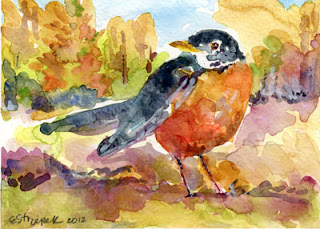 |
| Erica Dale Strzepek, Hearing Spring, Watercolor, 5x7 inches, ©2012 |
With three young boys, each hectic morning begins with breakfast, school lunches, and packing backpacks. During the winter, our routine is drab and resembles a scene from Director Bob Clark’s A Christmas Story, “I can’t put my arms down!” With spring’s arrival however, the mornings are fresh and less bulky. The world seems better listening to birds singing and seeing American Robins hunting for their breakfast of worms while we are eating ours.
Our town refreshes itself too as spring-cleaning begins in gusto. Dull winter lawns and empty lack luster flowerbeds are forgiven as hedgerows of forsythia bud and bloom. Large expanses of petite yellow blooms brighten otherwise still gloomy landscapes.
The blooming forsythia prompted a discussion and lesson in phenology from my husband, a practice second nature in his daily work routine. Merriam-Webster defines phenology as “a branch of science dealing with the relations between climate and periodic biological phenomena (as bird migration or plant flowering).”
“When the forsythia is half-yellow half-green, it’s time to apply pre-emergent weed control.” He continued with his examples, “Annual Bluegrass Weevil's timing control coincides with the blooming of the Pink Dogwood (cornus florida). The presence of clover (triflolium) can be an indication of low nitrogen. Clover is a legume which fixes its own nitrogen (N) from the air, the most abundant mineral in the air but not available to turf. If you see Broad-leaf Plantain (plantago major) it can be an indication soil compaction.”
His numerous fastidious accounts were enlightening. A more disciplined observation to the cues of nature and our surrounding environment is a lesson we can all benefit from.
Sunday, March 4
A Healthy Waiting Room
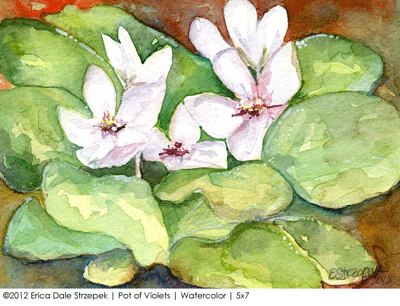
A neighbor friend of mine recently gave me a lovely pot of violets, an inspiring subject for a painter, but as I found out insightful as well.
She and her husband receive a pot of violets each time they visit their optometrist’s office. She continued to explain, she’d read an article in the waiting room on things to watch for when choosing a doctor. This list included taking note of the waiting room's plants. Do they look healthy, drab, or dead? The philosophy being if the doctor’s office fails to care for the plants under their supervision, what does this say about the care you will receive?
She was comforted by this observation, noting not only does their optometrist care for their plants, but they provide their patients with them. She had numerous violets about her kitchen counter and was happy to share one with me.
My original 5x7 watercolor, Pot of Violets, is available for sale from my Etsy Shop.
Subscribe to:
Posts (Atom)